Showing posts with label condensed milk. Show all posts

History of Carnation Milk Company

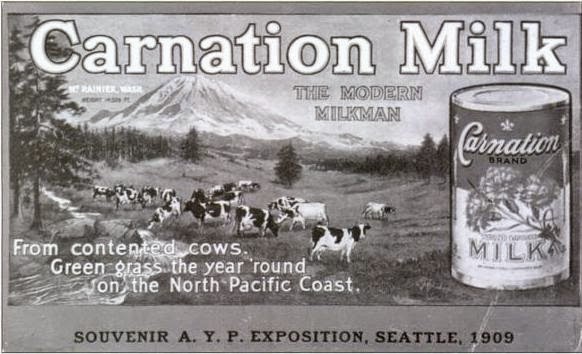
Pacific Coast Condensed Milk Company (later renamed the Carnation Milk Company) was established by Elbridge Amos Stuart at an existing factory located in King County, Washington, USA in August 1899. Stuart chose the Carnation name after seeing it used in conjunction with a display of cigars in a tobacco store in downtown Seattle.

The previous owners had been producing condensed milk – but when they went out of business Stuart took over the site. It made canned, evaporated milk for human consumption that was sold in grocery stores in the Pacific Northwest.

In 1910 Elbridge Amos Stuart bought 350 acres of timber and brush near Tolt. He cleared the land, diked the Snoqualmie River to control its flooding, and bought a purebred bull and 84 registered Holstein cows as the basis for a research dairy herd.

By 1929, Stuart's was the largest herd of purebred Holsteins in the world numbering 700. Washington State produced 7,500 pounds of milk per cow per year which was the highest in the nation. Stuart's operation in the Snoqualmie Valley was a model dairy which employed 75 men year round. Stuart acquired the property of the Albers Milling Company and employed it to house the Carnation Farm research facility.

That was Cheese John who came up with the idea of sterilizing the milk by subjecting it to high temperatures, thereby creating the first commercially-produced evaporated milk. The Carnation made evaporated milk until October 1, 1954, when a switch was made to producing the Carnation Instant Milk that had been invented earlier in the year.

In 1985 the Carnation brand was purchased by Nestlé.
History of Carnation Milk Company

Borden Company

Gail Borden Jr., the founder of the Borden Condensed Milk Company was born in Norwich, New York, in 1801. He moved west with his family as a young man and ultimately settled in Galveston, Texas.

He is best known for a process of using vacuum evaporator to kill bacteria in fresh milk. Borden called his unique product ‘condensed milk’. He took the patent for a system in 1856.

This process made it possible for Union troops to drink fresh milk during the Civil War - and for southerners and westerners to drink fresh milk after the war.

In 1857 Borden with his partners established a small company to produce his new product. In 1858, his partners sold out their share to Jeremiah Milbank, a New York City financier.

Under the new management, Borden’s Eagle Brand of condensed milk became a fast selling item.

The Civil War was a huge boost to the company, and even after licensing other manufacturers to produce condensed milk, Borden could not keep up with the demand for supplies for troops on both sides of the conflict.

In the 1920s, Borden’s company promoted infant welfare by teaching immigrant mothers that the best way to provide their infants with pure milk was to open a sterilized can of milk rather than buying powdered milk in bulk from a milk station.

In 1919 the company changed its name to the Borden Company and throughout the twentieth century purchased a number of smaller companies to capture supermarket shelf space.

In 1929 the company acquired a small company that made glue from casein, a by-product of skim milk.

Gail Borden Jr. died on January 11, 1874, in Borden leaving behind a thriving business, two sons and a host of inventions and parents.
Borden Company

Brand of Carnation

The first Carnation milk factory was located in Kent. And within one and one-half years the company went bankrupt.

Elbridge Amos Stuart (1856-1944) was a Quaker grocer from Indiana. Stuart learned of evaporated milk when he purchased one hundred cases of Highland Brand Condensed Milk from a Helvetia salesman.

He invested his savings to create new process, an unsweetened, sterilized, evaporated milk in cans, which then he sold in enormous quantities to gold seekers on their way to Klondike.

Stuart founded the Pacific Coast Condensed Milk Company in 1899 in Kent, Washington. The company was later renamed and moved to Carnation, Washington, a city that was named for the company’s dairy farms there.  The Pacific Coast Condensed Milk Company acquired the Carnation plant and machinery and on September 6 1899, produced the first case of evaporated milk.

The company would later change its name and become the world famous Carnation Milk Company.

In 1929 the Carnation Company acquired Albers Milling Company and added some of its research projects to those concerning cows. The result was a complex with kernels and catteries where pet food was tested.

In 1985, Nestle, the largest foods company in the world, acquired the Carnation Company.
Brand of Carnation

Business history of condensed milk

John Gail Borden the youngest son of the late Gail Borden, who was famous as an inventor and public benefactor, was born in Galveston, Texas, January 4, 1844.

Gail Borden moved from Texas to New York City in the late 1850s and within a few years developed and began operating the nation’s first condensed milk factory.

He was the first developed condensed milk in 1853 and it was not recommended by physicians until 1827.

Canned cow’s milk quickly became popular for a wide range of uses, as it was easy to transport and store.

At the beginning of the Civil War, Borden sold his canned milk to the Union Army, which ordered more cases than he could produce. After the war, condensation of milk made him rich.

By the end of the Civil War, Borden’s condensed milk was recognized nationally, thanks largely to huge Union Army contracts.

In 1861, Borden went into business in Wassaic, New York and sold his thick milk concentrate door to door. The philanthropist-investor Jeremiah Milbank underwrote production at Borden’s New York Condensed Milk Company.

Borden named his sweetened condensed milk Eagle Brand after national bird.

Between the 1890s and 1914 sweetened condensed mil became the main substitute for fresh milk and for mothers’ ilk in poorer families.

When refrigeration became more common, pasteurized fresh milk replaced the canned kind.
Business history of condensed milk

5 Most Popular Posts

Business and financial news - CNNMoney.com