Showing posts with label retail store. Show all posts

History of Sears

In 1886 Minnesota railway station agent, Richard W. Sears founded the R.W. Sears Watch Company in Minneapolis, Minnesota, to sell watches by mail order.

Initially, he bought a shipment of watches that a local jeweler refused to sign for. He established a side business selling the watches to other station agents before quit his railway job a few months later and established the R.W. Sears Watch Company in Minneapolis.

In 1887, Sears moved his watch-selling business from Minneapolis to Chicago and hired watchmaker Alvah C. Roebuck to assist him. While Roebuck's name would remain with the company for decades, ill health forced his retirement around the turn of the century.

Julius Rosenwald, a Chicago clothing merchant who became a partner in the firm in 1895, directed its rapid growth, expanding into new products and ever-broader territory.

By 1906, when it first issued stock to the public, Sears became the first major US retailer to sell its stock in an initial public offering, the company was capitalized at $40 million, had about 9,000 employees, and was approaching $50 million in annual sales.

The company built a massive Chicago distribution complex in 1906, which occupied three million square feet of floor space. In 1909, Rosenwald took over as president of the company. Rosenwald was able to save Sears from the brink of bankruptcy by pledging $21 million of his personal fortune and other assets to save the company.

In 2005, the company was bought by the management of the American big box discount chain Kmart, which upon completion of the merger, formed Sears Holdings. Through the 1980s, Sears was the largest retailer in the United States.
History of Sears

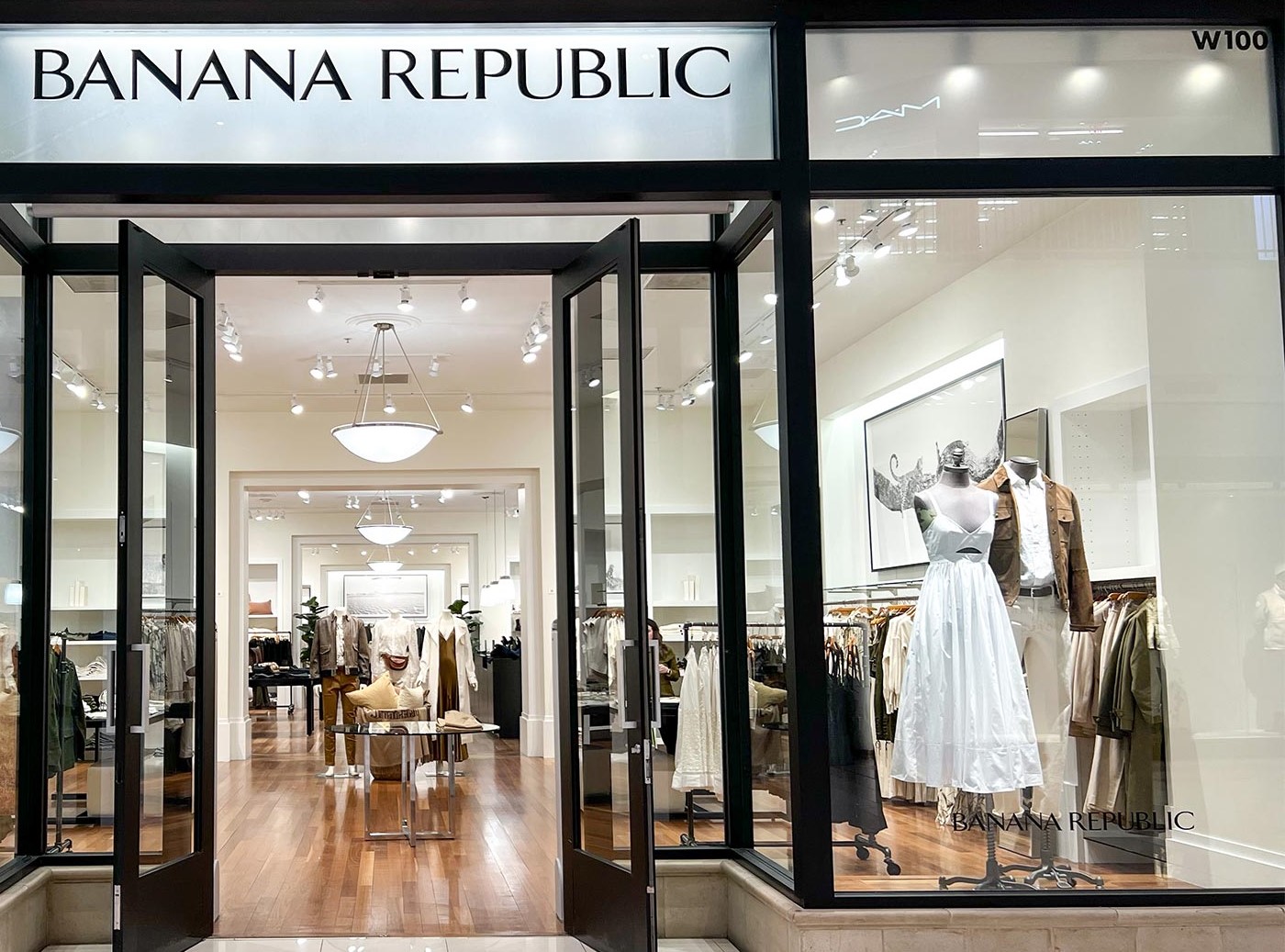
History of Banana Republic

Mel and Patricia Ziegler co-founded Banana Republic back in 1978. Mel was a reporter for the San Francisco Chronicle, and Patricia worked as a courtroom artist for the same paper. They lived in an apartment on Russian Hill.

Mel and Patricia Ziegler started the company with $1,500 and no retail experience. The company originally called the "Banana Republic Travel & Safari Clothing Company". The Zieglers sold refashioned military surplus in a safari-themed boutique, a whole new retail concept.

The company was bought by Gap in 1983 and now operates as a division, now with over 600 stores located internationally. They also co-founded The Republic of Tea and ZoZa.com.

Gap Inc. is primarily owned by the Fisher family, heirs of Donald George Fisher, who co-founded The Gap Inc. with his wife Doris F. Fisher, back in 1969.
In 2005, Banana Republic opened its first store in Japan. The store was located in Printemps Ginza in Ginza, Tokyo.

In 2011, Banana Republic’s Mad Men collection, a unique collaboration with the Emmy Award-winning television show’s costume director, Janie Bryant, hits stores. Two more collaborations follow in 2012 and 2013.

Banana Republic has struggled at Gap over the years, generally overshadowed by Athleta and Old Navy. In year 2021, compared to 2019, Banana Republic and Gap’s sales dropped by 15% and 10% in Q2, while Athleta and Old Navy’s sales increased by 35% and 21%, respectively.
History of Banana Republic

History of Macy's

In 1858, a small dry goods shop opened its doors on the comer of 14th Street and 6th Avenue in New York City. Macy’s was founded in 1858 by Rowland Hussey Macy with the original name R. H. Macy & Co. Rowland Hussey Macy adopted a red star as his symbol of success, dating back to his days as a sailor. He was a crewman on a whaling ship, where he received a red star tattoo on his arm.

Macy’s first-year sales were approximately $85,000 with an advertising budget of $2,800. In the following years, Macy began to grow his fledgling business. He started by expanding into 11 nearby buildings and adding merchandise categories.
Under the close supervision of Margaret Getchell, a Macy cousin and pioneer businesswoman, the department store grew during and after the Civil War and would eventually become a chain by the end of the nineteenth century.

In 1887 Nathan and Isidor Straus agreed to a deal to purchase part interest in the company. The acquisition was made official the following year, and by 1896 they had assumed full control.

In 1902, the store was moved to Herald Square, to a nine-story store. As a result of its new location, the department store was promoted and drew both locals and tourists.

Over 150 years and 800 stores later, the company grown into "America's Department Store," bringing their customers an experience that goes beyond just everyday shopping. Macy’s, Inc. sells a wide range of merchandise, including apparel and accessories (men’s, women’s and children’s), cosmetics, home furnishings and other consumer goods.

Overwhelmed by debt, in 1994 Macy's merged with Federated Department Stores, Inc., then the largest department store company in the US.
History of Macy's

History of Target Stores

The first Target store was opened on May 1st, 1962, in Roseville, Minnesota, suburb of St. Paul. It was owned by the Dayton Corporation.

Target actually can trace its origin back to 1902, when George Draper Dayton, a banker and real estate investor, opened a retail store called Goodfellows as a dry-goods store in downtown Minneapolis and became one of the dominant department stores in the Midwest.

In 1903, he changed the corporate name to The Dayton Dry Goods Company and in 1910 he changed it to The Dayton Company (Dayton). By the 1940s, it was a thriving family business that operated department stores called Dayton's in the upper Midwest region of the U.S.
During these early years, Dayton Company was run as a family enterprise and the influence of its founder’s values can still be seen in the corporation’s charitable activities and community involvement. In 1946, the company began its practice of donating five percent of profits to charity.

In 1965, the Dayton Company opened Southdale, the world’s first fully enclosed two-level shopping center, in suburb Minneapolis.

The first four Target stores made about $11 million in sales but did not make any profits in 1962. Slowly, sales began increasing and in 1965, sales were worth about $39 million. In the same year, another Target was opened in Minneapolis. In 1966, Target decided it was time to open stores outside Minneapolis. It opened two stores in Denver. In 1967, Target's parent company Dayton, went public.

The Target name has intentionally been chosen to differentiate the new discount retailer from the Dayton Company’s more upscale stores. Target was the first retail store to offer well-known national brands at low prices.

In 1995, the first Supertarget store opened in Omaha, Nebraska and in 1999 the Target.com website was launched.

In 1967, the Dayton Company went to public, and in 1969, it merged with the J.L Hudson Company of Detroit to create single entity, Dayton-Hudson Corporation.

In 1969 - Dayton merged with the J. L. Hudson Company to form the Dayton Hudson Corporation (DHC). The J. L. Hudson Company operated a chain of department stores called Hudson's in Detroit. Also in 1969, Target decided to open stores without supermarkets.

The Dayton Hudson Corporation also acquired Mervyns, becoming the 7th largest U.S. retailer. By 1979, however, Target became the corporation’s largest source of revenue, surpassing the department store division. Dayton Hudson acquired Marshall Fields in 1990.

In 2000, the parent company, Dayton Hudson, officially changed its name to the Target Corporation.
History of Target Stores
Updated version from: Target Corporation

Target Corporation

The first Target store was opened on May 1st, 1962, in Roseville, Minnesota, suburb of St. Paul. It was owned by the Dayton Corporation.

Target actually can trace its origin back to 1902, when George Draper Dayton opened a retail store called Goodfellows as a dry-goods store in downtown Minneapolis and became one of the dominant department stores in the Midwest.

In 1903, the name of the store was changed to the Dayton Dry Goods Company.

In 1910, the name changed again to the Dayton Company. In 1965, the Dayton Company opened Southdale, the world’s first fully enclosed two-level shopping center, in suburb Minneapolis.

And by 1962, the Dayton Company entered the full-line discounting arena by opening target. The Target name has intentionally been chosen to differentiate the new discount retailer from the Dayton Company’s more upscale stores.

In 1995, the first Supertarget store opened in Omaha, Nebraska and in 1999 the Target.com website was launched.

In 1967, the Dayton Company went to public, and in 1969, it merged with the J.L Hudson Company of Detroit to create single entity, Dayton-Hudson Corporation.

In 2000, the parent company, Dayton Hudson, officially changed its name to the Target Corporation.
Target Corporation

History of Selfridges department store London

In 1906 a man called Harry Gordon Selfridge came to London from the United States with an idea for an exciting new department store.

The store opened on 15th March 1909 and the West End had never seen anything like it.  Selfridges was opened using capital from another London store owner, Sam Waring of Waring and Gillow located further east in Oxford Street, on condition that Selfridges did not sell furniture.’

When opening the department store, his vision was to showcase things whose novelty and uniqueness could delight and excite his customers.

Three years after opening, a roof garden was added, followed in 1913 by a ‘seaside’ children’s play area. After a slow start, the store proved highly successful, generating in 1914 profits of £131,546.

The first public demonstration of television was made here by John Logie Baird in 1925.
,
Selfridges was acquired by the Sears Group in 1965 and in 1998, it de-merged and listed itself on the London Stock Exchange.

In 2004, it was reregistered as a private company known as Selfridges & Co.
History of Selfridges department store London

History of JC Penny


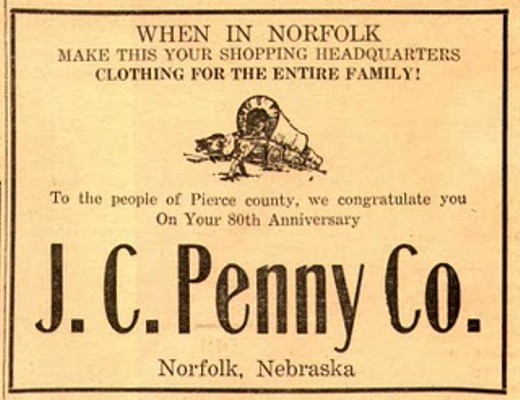
J.C. Penney & Co. was founded in 1902 by James Cash Penney and William Henry McManus. Penny moved to Kemmerer in 1902 from Evanston to open dry goods store in the booming mining town.

He was born in Missouri, he worked for eight years in a Missouri dry goods store before moving to west.

The original name for the store that started J.C. Penney in the dry goods business was The Golden Rule.

By 1912 there were 34 Golden Rule stores, but the following year it was changed to JC Penney when Penney accepted a majority ownership of the chain, William McManus still being a partner.

In two year alone from 1915 to 1917 the company grew from 83 stores to 175. The chain expand rapidly as stores mangers were allowed to open new stores, keeping one quarter of the profits, as soon as they were successful.

This simple concept led the store massive expansion and making it the second-biggest retailer in the country by 1970.

The mother store is located in Kemmerer, Wyoming and still operates as of 2007.

During the postwar economic boom of the 1950s and 1960s, as many Americans move to suburbs, so did JC Penney, taken advantage of the retail space offered by the boom in shopping malls by becoming the anchor store in shopping stores across the country.


Today, most J.C. Penney stores are located in suburban shopping malls. Previously, most stores were located in downtown areas.

However, in recent years, the chain has been following a retailing trend in opening some standalone stores. The company is an Internet retailer and has undergone significant institutional changes to compete in the ever changing retail landscape.

It operates the nation’s largest general catalog business, as well as jcpenney.com, one of the largest apparel and home furnishings sites in the internet, with over $1 billion in annual sales.

Increased competition from big box retailers like Wal-Mart and Target have forced J.C. Penney to focus on private brands such as St. John's Bay, Worthington, nick(it) and Arizona Jean Company.
History of JC Penny

5 Most Popular Posts

Business and financial news - CNNMoney.com