Showing posts with label brand. Show all posts

Nutella: A Sweet Journey of Innovation and Global Appeal

Nutella, the beloved hazelnut spread, has a fascinating history that reflects innovation and resilience. Its origins trace back to post-World War II Italy, a time marked by economic hardship and scarcity. Cocoa, a key ingredient in chocolate, was in short supply. Pietro Ferrero, a resourceful pastry maker from Alba, Piedmont, sought to create an affordable yet delightful chocolate treat. In 1946, he introduced "Pasta Gianduja," a solid block of sweetened hazelnut paste blended with a small amount of cocoa. This creation was inspired by gianduja, a traditional Italian confection made from hazelnuts and chocolate, which dates back to Napoleonic times when cocoa was similarly scarce.

By 1951, Ferrero had refined his recipe, creating a creamier version known as "Supercrema." This innovation made the product easier to spread and more versatile, increasing its appeal. The breakthrough came in 1964 when Pietro’s son, Michele Ferrero, rebranded the product as "Nutella." The name cleverly combines the English word "nut" with the Latin suffix "ella," implying sweetness and charm. This rebranding coincided with a growing global appetite for unique and convenient food products, paving the way for Nutella's international success.

The secret to Nutella’s widespread appeal lies in its harmonious blend of hazelnuts, cocoa, sugar, and skimmed milk, creating a creamy and indulgent texture. Over the decades, the Ferrero Group has maintained its commitment to quality, sourcing premium ingredients and adhering to strict production standards. This dedication has helped Nutella become a household staple in over 160 countries. Beyond its role as a breakfast spread, Nutella has inspired a plethora of culinary innovations, from pancakes and waffles to desserts like Nutella-stuffed croissants and gelato.

Recent years have seen the brand embrace sustainability. The Ferrero Group has committed to sourcing 100% certified sustainable palm oil and achieving full traceability of its hazelnut supply chain by 2025. These efforts address environmental concerns while ensuring the long-term availability of high-quality ingredients.

In conclusion, Nutella’s journey from a modest hazelnut paste to a global icon exemplifies the power of innovation and adaptability. Its enduring popularity reflects not only its delicious flavor but also the Ferrero family’s unwavering dedication to quality and sustainability, ensuring its place in the hearts of generations to come.
Nutella: A Sweet Journey of Innovation and Global Appeal

Fiji Water Business History

In 1996, Canadian hotelier and entrepreneur David Gilmour founded the FIJI Water Company, originally named Natural Waters of Viti Ltd. Gilmour, who owned the exclusive Wakaya Club hotel situated on a private island near Levuka, noticed that guests, including notable figures like Bill Gates, brought their own bottled water due to concerns about the local water supply on the secluded tropical island and a preference for luxury.

Prompted by this observation, Gilmour, with the support of geologists from his Barrick Gold Company, identified a high-quality water source in the Yaqara valley. Securing a long-term lease for 20 acres, he constructed a bottling plant with the goal of producing a bottled water as unique as the islands themselves.

Gilmour's prior business and government connections in Fiji, stemming from his resort development, along with favorable business conditions in Fiji, contributed to the expansion of Natural Waters of Viti Levu, commonly known as Fiji Water.

Positioning itself as a symbol of sophistication and environmental responsibility, Fiji Water claimed to produce a premium product with "sustainable practices." The water, classified as "artesian," is drawn from an artesian aquifer in Fiji's Yaqara Valley, nestled on the northern part of Viti Levu, the largest Fijian island.

The water source, a pristine 17-mile-long aquifer on government-owned land, was secured by Gilmour through a 99-year lease. While the Fijian government lacked the means to tap into the aquifer for its own population, Fiji Water gained nearly exclusive access to this crucial freshwater reserve.

Sales to the USA commenced in 1997, with production experiencing rapid growth from 10 million bottles in 1998 to 25 million bottles in 2000, necessitating the construction of a new factory. In 2004, the affluent couple Steward and Lynda Resnick, proprietors of Roll International, a private company, purchased Fiji Water from Gilmour for US$50 million.
Fiji Water Business History

History of Sunsilk brand

Sunsilk is a hair care brand, primarily aimed at women, produced by the Unilever group. Unilever has been in business since the 1880s, is a British-Dutch multinational consumer goods company, was formed in 1930 as a result of a merger between British Soap maker Lever Brothers and Dutch margarine producer Margarine Union.

Sunsilk was launched in the UK in 1954, and by 1959 it was available in 18 different countries worldwide. The product was available in a bottle, allowing up to seven washes, and in a sachet; both featured a red stylised sun pattern. It was marketed with the slogan ‘Shampoos sunshine into your hair’

Its first logo was a black “Sunsilk” lettering in a typeface roughly similar to SoftMaker’s Thames Serial Bold. The first letter was capitalized, and all the rest were in lowercase. Long serifs and great contrast between the main and additional strokes created a sense of dynamics.
In 1958, a new transparent polythene tube for the liquid shampoo was introduced as an alternative large size pack to the bottle. Sunsilk was also available in such tubes.

Sunsilk began advertising in 1955 with a campaign that focused on specific hair "issues". In the UK, the campaign focused on shiny hair. By 1959, it had become a well-known hair care brand and was available in 18 countries worldwide.

Sunsilk significantly improved product formula and launched new variants in 1966. For example, the first major shampoo to contain olive oil, which acted as conditioner to make hair soft and manageable, shampoo for dull hair, which restored hair’s natural shine and lemon shampoo for greasy hair with deep cleansing ingredients.

During the 1960s, a television commercial of Sunsilk featured a tune composed by John Barry, “The girl with the sun in her hair”, which proved so popular that it was subsequently released as a pop single.

Madonna, Natalia Oreiro, Shakira, and Marilyn Monroe all featured in Sunsilk's 2008 advertising campaign “Life Can’t Wait” which launched with a Super Bowl XLII spot.

Sunsilk introduced in 1989 with three variants related to hair type endorsement of a hair stylist was the first step in building the image of brand as health care expert. With thecompetition of local and multinational companies due to rationalize of excise duties, Sunsilk has not been able to take market share.
History of Sunsilk brand

Milkmaid brand of milk

In 1866, US brothers Charles and George Page help establish Anglo-Swiss Condensed Milk Company in Cham, Switzerland. A year later, the Pages opened Europe’s first condensed milk factory in Cham, and their Milkmaid Brand began to roll off the production line. They start supplying Europe’s industrial towns with the product under the Milkmaid brand, marketing it as a safe, long-life alternative to fresh milk.

High standards of quality and safety, a modern factory, efficient distribution and savvy marketing ensured the product was a success. The brand that began Nestlé’s history is still sold today as Nestlé Milkmaid.

Advertisements for Milkmaid appeared first weekly and then even daily throughout the 1890s. They always focused on the fact that Milkmaid was the best selling tinned milk worldwide.

Marketing it as a safe, long-life alternative to fresh milk, they started supplying Europe’s industrial towns with the product under the Milkmaid brand. The milkmaid has become a symbol of this widely distributed brand.
Milkmaid brand of milk

Dr. Scholl's

Scholl Manufacturing Company was founded in Chicago in 1906 and named eponymously after William Mathias Scholl.

A medical student, Scholl manufactured and marketed foot-care products such as the ‘Foot-Eazer’ and an array of foot plasters and powders; in time, his arch supports would be associated with the global Dr Scholl brand. Foot-Eazer was patented in 1904.

Dr Scholl took over the Western Wheel Works building in 1904 and manufactured shoes here until the late twentieth century.

William Scholl later branched out into products for shoe injuries bunion pads, callus protectors, corn pads, and sole inserts.

His brother Franck opened Dr Scholl’s London Foot Comfort Shop in 1913, setting the pattern for ensuing decades, during which the Scholl Manufacturing Co. among other things launched a line of Dr Scholl branded shoes.

Today the name Dr Scholl’s is symbolic of quick relief to foot sufferers everywhere.
Dr. Scholl's

Tupperware Corporation

Earl Silas Tupper (1907-1983), a twentieth-century Benjamin Franklin, established Tupper Plastics Company in 1939 and developed the first Tupperware prototype around 1942.

Earl Silas Tupper was one of the pioneers in the conversion of polyethylene in the house wares and founder of Tupper Corporation.

Tupper’s breakthrough came with a milky white, injection-molded plastic ‘bell tumbler’, which launched the Tupperware line. Tupperware products were first introduced to the public in 1945.

Originally, Tupperware was distributed conventionally through retail store and it slightly higher price, create problem.  Many consumers distrusted plastics and were uncertain about how to use the new seals.

In 1951, a sales organization called Tupperware Home Parties was created to administer sales. Soon, Tupperware ‘parties’ became a common activity of American life. The marketing move was highly profitable and sales soared to more than $100 million within just a few years.

In 1958, Dart Industries purchased the Tupperware Corporation as well as Tupper Home Parties.

Throughout the 1980s and into the late 1990s, Tupperware consistently evolved, in terms of its product design and party plan, in keeping with social and cultural change.

By the 2000, the Tupperware Corporation anticipates expanded markets in China, India and Central Europe. As of 2002, Tupperware had more than a million sales consultants located in more than one hundred countries.
Tupperware Corporation

Beatrice Foods Company

George Everett Haskell, a bookkeeper with the Fremont Butter and Egg Company purchased the company’s Nebraska plant when the company folded in 1891. It was the vision of Haskell and his successors, principally Clinton H. Haskell and William G. Karnes that guided them in building Beatrice Foods Company into one of the world’s leading companies.

Late in 1894, Haskell began churning butter at Beatrice and using their own delivery wagons to distributive creamery butter in the special protective packages that they has devised to grocery stores, restaurants and hotels.

He renamed it the Beatrice Creamery Company. In 1901 the company adopted the trademark Meadow Gold for its butter.

The company is reported to have been the first company to package butter in sealed cartons. In 1931 Beatrice was the first company to advertise its ice cream products nationally.

The company bought Blue Valley in 1939, moved to Chicago from Beatrice, Nebraska in 1913 and established its headquarters at 1526 South State Street.

In attempt to expand its product line, the company purchased La Choy, a producer of Asian Foods, in 1943.

In 1984 Beatrice Food purchased Hunt-Wesson Inc, a large food products company in California. In the same year, Beatrice launched its first ad campaign, stamping its name on every product within the company. The ads, created by Marsteller, of Chicago, Illinois, showed Beatrice’s products and then introduced the company with the tag-line, ‘Beatrice. You’ve known us all along’.

Beatrice has become a slimmer and more focused company in the early 2000s. In 1987, Lewis and TLC bought Beatrice Foods for $985 million and repositioning it as a food conglomerate with sixty-four company in thirty-one countries.

By January 1993, Beatrice Food’s annual revenue exceeds $2.5 billion.
Beatrice Foods Company

History of Maggi brand of Nestlé

Maggi is owned by Nestlé: seasonings are their main products. Maggi really grew on its dehydrated soups-an instant food at the start of the industrial revolution.

The original owner was Julius Michael Johannes Maggi in Switzerland.

In 1883, Julius Maggi produced appliances for roasting and grinding vegetables, to make flour form peas, beans, lentils, etc. enabling women to make a quick nourishing soup.

His objective was to provide nutritious and flavorful meals for working class women who lacked the time ad money to prepare proper home cooked meals.

Eventually in Maggi put his instant product vegetable powders on the market, under his friend Doctor Schuler’s patronage. Julius Maggi started produced first instant soup in his Kemptthal factory in 1886, followed by various kinds of soups in cubes or bags and even beef cubes in 1908.

The Maggi soups and seasoning business was acquired in 1947 by Nestlé by merging with the Alimentana S.A becoming Nestle Alimentana Company.

Finding its core customer aging during the 1980s and 1990s, Maggi reached out to the younger generation with meal-maker products, ready to eat foods, and frozen snacks as well as ethnic and children’s product lines.
History of Maggi brand of Nestlé

Paper mate

Fran Seech was an unemployed chemist who had work for a ballpoint pen company that went bankrupt in the big pen bust in early 1950s.

Working out of his house, Seech invented a new ink formula. In 1949, Patrick J. Frawley Jr bought Seech formula. With an investment of $40,000, he bought the Todd Pen Company, changing its name to the Frawley Corporation.

Frawley improved the design and in 1950 he began producing a pen he called Paper Mate.

It was an immediate success, and within a few years, Paper Mates were selling in their millions around the world.

In 1950, the company’s sales were $500,000. By the following years, they had reached $12 m, and by 1953, the company was turning over $20 m in sales.

By the mid 1950s, Gillette had entered the ballpoint pen business with the acquisition of Paper Mate for $15.5 million.

In 1979 the Paper Mate Company introduced an erasable ball-point.
Paper mate

History of Tissot

Founded in 1853, Tissot is proud to display, the Swiss flag at the heart of its T logo. The founders were Charles-Felicien Tissot and his son, Charles-Emile Tissot (1830-1910). The firm was located in Le Lode, Switzerland.

Tissot supplied watches to Russia and the ‘Tsar’s Court.’

Tissot has created many first in the watch world. They created the first antimagnetic watch, and also were the first to produce the plastic watch.

Tissot merged with the Omega Watch Co. in 1929 to form SSIH. At the same time Longines, Rado and Swatch merged into ASUAG. At the beginning of the 1980s, in the midst of the decline of the Swiss watch industry, the two firms were bailed out of financial distress by local banks.

The two firms later merged to form ASUAG-SSIH, which was finally taken over by a group of private investor led by Nicholas Hayek and re named the Swatch Group.

Today Tissot still produce a line of quality watches today, including chronometer escapements.
History of Tissot

History of Swatch watches

At the end of the 20th century, analog watches were considered out of fashion. The Swiss watch industry was facing fierce competition from Japanese. So Swiss watchmakers joined forces with designers from all over the world formed a new watch company that could make parts so cheaply that is was more reasonable to throw the watch away than to repair it.

Hence the Swiss Watch Company (SWATCH) was born. They were launching high precision watches at a low price.

Swatch was developed by a team of ETA engineers under Thomke’s supervision to beat the Japanese competition, the Swatch was a fashion product and a plastic quartz watch manufactured in Switzerland.

It was launched in 1983 and experienced growing popularity worldwide from the late 1980s onwards. It was explained that the introduction of simplified mechanism using only 51 parts as opposed to the standard 91 parts. This is one reason why the Swatch could be made so slim and cost brought down.

Swatch was revolutionary because it changed the whole paradigm of what a watch is. A watch was no longer regarded as a timepiece, but as an accessory. Swatch watches may made from more expensive materials and may be sponsored or designed by well-known artist.
History of Swatch watches

Van Houten chocolate

In 1815, Coenraad Johannes van Houten (1801-1887), a Dutch chemist, began work on his Amsterdam factory on a process that would revolutionize the manufacture of drinking chocolate while paving for eating chocolate.

In 1828 he patented a press that removed most of the bitter fat, which accounts for more than half the weight, from the ground, roasted beans. He pioneered a pressing process for milling cocoa he removed the center of the bean –called nib – in order to make the resulting paste more digestible.

Van Houten also went on to treat the coca with alkaline salts to improve it blending with hot water. This process is known as ‘Dutching’. The process made its cocoa essence more soluble and more ‘chocolatey’ in taste.

For the first time, cheap chocolate powder could be produces for the masses. Ten years after he had patented the process van Houten sold the rights to his cocoa press. One of his first customers was J.S Fry & Sons of Bristol, England.

Van Houten established a new steam-powered factory in 1850, close to Amsterdam.

Van Houten sold his cocoa to candy makers, housewife and bakers. In 1877, C.J van Houten and Zoon, of Weesp, Holland applied for a British trademark, which was registered for Van Houten’s Pure Soluble Cocoa until 1989.

The English firm of Cadbury reproduced the technology of van Houten and quickly became the leading British confectioner, due to its marketing strategy of connecting boxes of chocolate candies to romance: boxes of chocolates were demanded by men to be given to their special lady friends.
Van Houten chocolate

History of Duracell battery

Ruben cell is a zinc-mercuric oxide alkaline cell, more commonly called a mercury battery. It is a type of primary cell, developed by Samuel Ruben during World War II in response to a requirement for battery with a high capacity to volume ratio.

It was licensed to the P. R. Mallory Co., (later became Duracell, International). When Kodak required a new cell size battery for its integrated flash camera, the company developed the AA size alkaline battery, combining the two words ‘durable’ and ‘cell’ into Duracell. The Mallory Battery Company, as it came to b known during World War II, introduced the Duracell brand in 1964.

Duracell is the bestselling brand of batteries because it is the one with the clearest and most singular identity.

In 1974, Duracell became the first company to advertise alkaline batteries on television.

In1978, the Mallory Battery Company and the Duracell name was acquired by Dart Industries. During 1987, Duracell use Laurel and Hardy dolls in a car chase US TV advert, as well as featuring them in drawings in competitions.

The company was acquired by Gillette in 1996, and in 2005 Procter and Gamble acquired Gillette.
History of Duracell battery


Borden Company

Gail Borden Jr., the founder of the Borden Condensed Milk Company was born in Norwich, New York, in 1801. He moved west with his family as a young man and ultimately settled in Galveston, Texas.

He is best known for a process of using vacuum evaporator to kill bacteria in fresh milk. Borden called his unique product ‘condensed milk’. He took the patent for a system in 1856.

This process made it possible for Union troops to drink fresh milk during the Civil War - and for southerners and westerners to drink fresh milk after the war.

In 1857 Borden with his partners established a small company to produce his new product. In 1858, his partners sold out their share to Jeremiah Milbank, a New York City financier.

Under the new management, Borden’s Eagle Brand of condensed milk became a fast selling item.

The Civil War was a huge boost to the company, and even after licensing other manufacturers to produce condensed milk, Borden could not keep up with the demand for supplies for troops on both sides of the conflict.

In the 1920s, Borden’s company promoted infant welfare by teaching immigrant mothers that the best way to provide their infants with pure milk was to open a sterilized can of milk rather than buying powdered milk in bulk from a milk station.

In 1919 the company changed its name to the Borden Company and throughout the twentieth century purchased a number of smaller companies to capture supermarket shelf space.

In 1929 the company acquired a small company that made glue from casein, a by-product of skim milk.

Gail Borden Jr. died on January 11, 1874, in Borden leaving behind a thriving business, two sons and a host of inventions and parents.
Borden Company

Giorgio Armani– Italian fashion designer

Giorgio Armani was born in 1934. He is an Italian fashion designer and began his career in 1964.  He abandoned medical school and worked as a buyer for a department store (1957-64) before training as a fashion designer.

He created Giorgio Armani label in 1975 and in 1982 he appeared on the cover of Time, putting the final seal of approval in his fame.

In 1980 - 81 he founded Giorgio Armani USA, Emporio Armani and Armani Jeans and in 1989 he opened shops in London.

He was a leader in the pared-down, unstructured silhouette in menswear and was responsible for the shouldered look for executive women.

The name Armani became synonymous with sex appeal in the 1980s as the Hollywood blockbuster American Gigolo, staring Richard Gere, featured Armani in numerous key scenes, including Gere’s character shopping for suits in a luxurious retailer.

Looking back at the impact of American Gigolo has publicity-wise, Armani realized that the best way to reach that middle American audience was to dress its star.

The cachet of Armani suits was further bolstered when Armani designed the retro-1930s costumes for Brian De Palma’s gangsters flick The Untouchables, the 1987 cinematic portrayal of the downfall of Al Capone.

Among the many prizes awarded to him, he has won the prestigious Cutty Sark Award for the Best International Men’s Wear fashion designer more than once.
Giorgio Armani – Italian fashion designer

History of Nike Inc.

Philip Hampson Knight ran track for Coach Bill Bowerman at the University of Oregon in the 1960s. Knight was a member of the school’s track team. His coach Bowerman always experiments with running shoes in order to make his team running faster.

Knight started his own athletic shoe distribution company in 1964. Using his Plymouth Reliant as a warehouse, he began importing and distributing track shoes from Onitsuka Company, ltd, a Japanese manufacturer.

Knight sent several pairs as a sample to Bowerman. Bowerman was pleased with samples and made Knight a proposal he could not refuse.

In 1964, the men formed Blue Ribbon Sports, the precursor to Nike, by shaking hands and each committing to proffer $500 in start-up capitals. Blue Ribbon Sports was founded in Eugene, Oregon USA, as a distributor for running shoes produced by Japan.

However, Onitsuka saw the huge potential of the American shoe market and dropped Knight’s relatively small company in favor of larger, more experienced distributors.

In around 1970-71 Bowerman developed a lightweight, gridlike sole after testing out liquid polyurethane in his wife’s waffle iron and this eventually led to the launch of the Waffle trainer in 1974, the company’s first national best seller.

They went on together to start the Nike Corporation in 1972. Nike became Nike legally in 1978. By 1980 Nike had reached a 50 percent market share in the United States athletic shoe market.

By the end of 1980, Nike completed its IPO and became a publicly traded company.

Nike does not own a single shoe or apparel factory. Instead, the firm contracts the production of its products to independently owned manufactures.

Today, practically all Nike subcontracted factories are in countries such as Indonesia, Vietnam, China, and Thailand.
History of Nike Inc.

History of Brylcreem

Starting in 1929, Brylcreem became one of the best-known, brand name products in America and Europe. 

Created in 1928 by the Birmingham County Chemical Company in Britain, the product, first sold as Elite Hair Dressing Cream, was intended to keep hair in place.

It was first advertised on TV by the jingle, ‘Brylcreem, A Little Dab’ll Do Ya!’ In 1939, the company was acquired by Beecham.

Brylcreem was the truly mass marketed men’s hair care product. It was issued to British soldiers as part of their personal care kits during World War II.

Brylcreem, originally used mainly by elder men and regarded as a cash cow by SmithKline Beecham, was re-launched targeting young men when Sara Lee bought the brand in 1993.
History of Brylcreem

History of Quaker Oats Company

History of Quaker Oats Company
The Quaker Oats Company has been around for over 120 years producing many different products and cereals. It all started with The Quaker Mills Company in Ravenna, Ohio when Henry D. Seymour and William Heston registered the Quaker trademark in 1877. Later Henry Crowell purchased the company and quickly gained acceptance from the public in part because of his method of packaging the oats in a two pound paper package with cooking directions. This is understandable as the method of packaging by his rivals were in the not-so-handy 180 lb barrels. He was called a cereal tycoon at that time.

It is unclear exactly how many different companies were involved in the late 1880s, but others involved in the formation of Quaker Oats, include Ferdinand Schumacher known as “The Oatmeal King” (American Oatmeal Company), John Stuart, his son Robert and George from cereal mills of Cedar Rapids.

Another on was Rob Lewis & Co. American Oats and Barley Oatmeal Corporation.

Over the years many different premiums were given out to promote the Quaker man, starting with trade cards and puzzles in 1900 era, to cookie jars in 1997. The most popular premium in the 1950's was Sgt Preston of the Yukon Promotion with free deeds for one square inch of land in the Yukon Territory.

The symbol of a man in Quaker dress was registered as a trademark in 1877 by forerunner of the Quaker Oats Company. This symbol was chosen because it was considered that Quakers represented an image of purity and honesty. This move was seminal, because Quaker Oats was the first cereal to be marketed as a brand rather than a commodity.

Further more, in 1886 Quaker oats pioneered the retail sale of cereals in packages. These developments helped to establish oatmeal as the most popular breakfast item in the United States and as a significant ingredient in many ready to eat cereals and other food products.

In August 2001, after one hundred years a publicly traded company, Quaker Oats Company merged with PepsiCo, Inc.
History of Quaker Oats Company

History of JC Penny


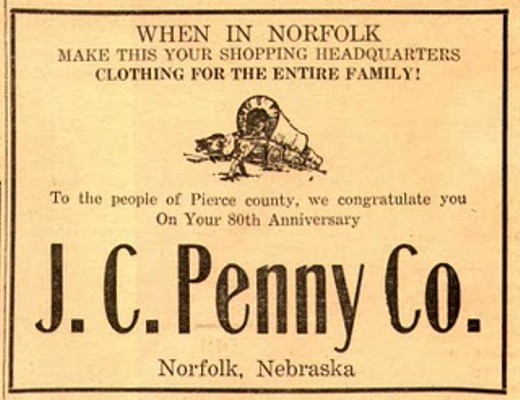
J.C. Penney & Co. was founded in 1902 by James Cash Penney and William Henry McManus. Penny moved to Kemmerer in 1902 from Evanston to open dry goods store in the booming mining town.

He was born in Missouri, he worked for eight years in a Missouri dry goods store before moving to west.

The original name for the store that started J.C. Penney in the dry goods business was The Golden Rule.

By 1912 there were 34 Golden Rule stores, but the following year it was changed to JC Penney when Penney accepted a majority ownership of the chain, William McManus still being a partner.

In two year alone from 1915 to 1917 the company grew from 83 stores to 175. The chain expand rapidly as stores mangers were allowed to open new stores, keeping one quarter of the profits, as soon as they were successful.

This simple concept led the store massive expansion and making it the second-biggest retailer in the country by 1970.

The mother store is located in Kemmerer, Wyoming and still operates as of 2007.

During the postwar economic boom of the 1950s and 1960s, as many Americans move to suburbs, so did JC Penney, taken advantage of the retail space offered by the boom in shopping malls by becoming the anchor store in shopping stores across the country.


Today, most J.C. Penney stores are located in suburban shopping malls. Previously, most stores were located in downtown areas.

However, in recent years, the chain has been following a retailing trend in opening some standalone stores. The company is an Internet retailer and has undergone significant institutional changes to compete in the ever changing retail landscape.

It operates the nation’s largest general catalog business, as well as jcpenney.com, one of the largest apparel and home furnishings sites in the internet, with over $1 billion in annual sales.

Increased competition from big box retailers like Wal-Mart and Target have forced J.C. Penney to focus on private brands such as St. John's Bay, Worthington, nick(it) and Arizona Jean Company.
History of JC Penny

5 Most Popular Posts

Business and financial news - CNNMoney.com